It is difficult to improve a compressed-air system without knowing exactly how much air the business uses, when demand is highest and how system performance changes throughout the working week.
Assumptions based on compressor size or production schedules rarely provide the complete picture. Compressed-air flow monitoring replaces these assumptions with measured data, helping businesses understand actual demand and identify opportunities to reduce waste, control costs and improve system performance.
What Is Compressed-Air Flow Monitoring?
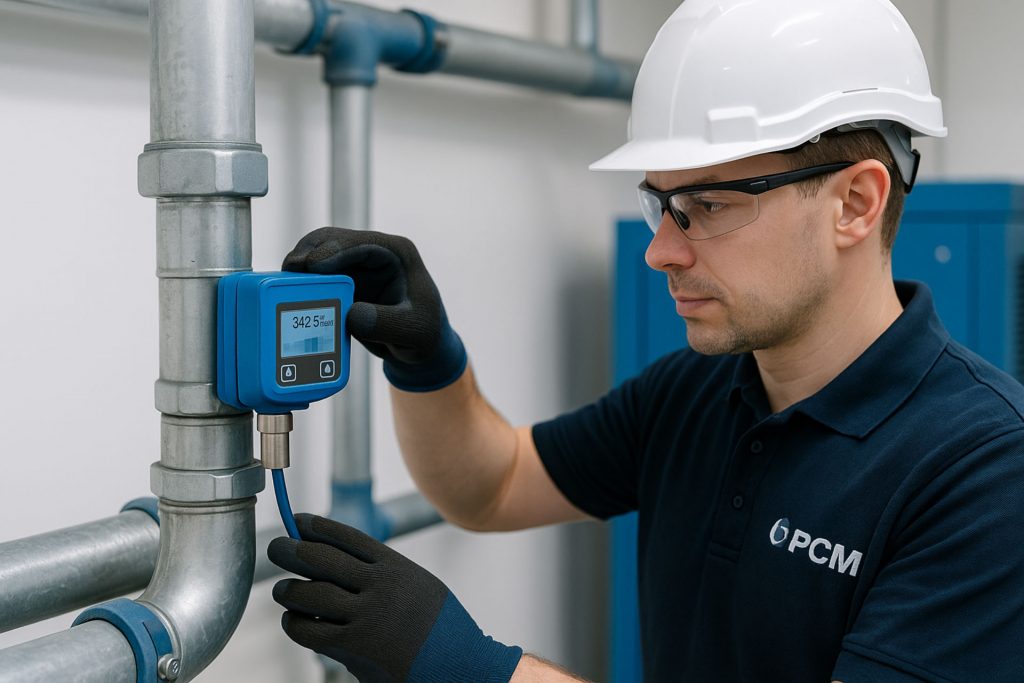
Flow monitoring measures the volume of compressed air moving through a system over time. Depending on the monitoring equipment used, pressure and temperature may also be recorded to provide a more complete view of system performance.
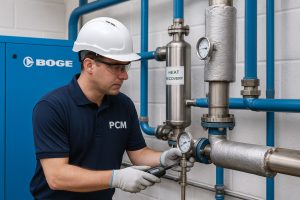
Meters and data loggers can be installed at strategic locations, including:
- The compressor outlet
- The main distribution header
- Individual production areas
- Departmental feeds
- High-demand equipment or processes
Monitoring over different shifts and production conditions creates an accurate demand profile rather than relying on a single reading taken at one moment.
1. Understand Your True Air Demand
Compressed-air demand can change considerably during the day. Production start-ups, shift changes and individual processes may create short periods of high demand that are difficult to identify without recorded data.
Flow monitoring reveals:
- Normal operating demand
- Peak consumption
- Low-demand periods
- Changes between shifts
- Weekend and out-of-hours usage
- Sudden increases in consumption
This information helps determine whether the existing compressor arrangement is meeting demand efficiently.
2. Identify Out-of-Hours Waste
Compressed-air consumption should fall significantly when production equipment is switched off. If flow remains unusually high during breaks, overnight periods or weekends, air may be escaping through leaks or equipment may have been left connected unnecessarily.
Flow data can reveal this standing demand and help businesses understand the scale of potential waste.
Flow monitoring does not replace a dedicated leak-detection survey, which identifies the locations of individual leaks. However, combining the two services can show both the overall level of waste and the specific repairs required.
3. Avoid Incorrect Compressor Sizing
Choosing a compressor based only on the size of the existing machine can lead to equipment being incorrectly specified.
An oversized compressor may run inefficiently during normal production, while an undersized compressor may struggle during periods of peak demand. Accurate flow data provides evidence of the system’s actual requirements and helps identify the most appropriate compressor capacity and control method.
This is particularly useful when:
- Replacing an existing compressor
- Adding production equipment
- Expanding a facility
- Reviewing a multi-compressor arrangement
- Considering fixed-speed or variable-speed equipment
4. Investigate Pressure Problems
Low pressure at the point of use does not always mean the compressor is too small. The underlying cause could be restricted pipework, an undersized filter, poor system design or a sudden increase in demand.
Monitoring flow and pressure together can help identify when pressure fluctuations occur and whether they correspond with particular production activities.
This allows the cause of the problem to be investigated before compressor pressure is increased unnecessarily.
5. Measure the Results of Efficiency Improvements
Flow monitoring can establish a performance baseline before changes are made to the system. The system can then be measured again following improvements such as:
- Repairing compressed-air leaks
- Reducing operating pressure
- Upgrading pipework
- Installing additional air storage
- Improving compressor controls
- Replacing inefficient equipment
Comparing the results provides clear evidence of whether the project has reduced consumption and improved system performance.
6. Plan for Future Demand
Businesses often need to know whether their existing compressed-air system can support additional machinery or increased production.
Historical flow data shows how much capacity is currently being used and how frequently peak demand occurs. This allows future upgrades to be planned using measured information rather than estimates.
It may reveal that extra capacity is required—or that improvements to storage, pipework or compressor control could meet the new demand without installing a larger compressor.
How Does the Monitoring Process Work?
The process normally begins with a review of the compressor room, distribution system and operating schedule. Suitable monitoring points are then selected, and flow meters or data loggers are installed.
Data is recorded over a representative period to capture normal production, peak demand, shutdown periods and different operating shifts.
The collected information is analysed and presented in a clear report showing how compressed air is being generated and consumed. Recommendations can then be made around leak management, pressure settings, equipment control, pipework or future upgrades.
Stop Guessing and Start Measuring
Compressed air can represent a significant operating cost, but its consumption is often much less visible than electricity, fuel or water.
Flow monitoring gives businesses the information needed to make informed decisions, prioritise improvements and confirm whether changes are delivering results.
PCM Air Power provides compressed-air flow monitoring using professional metering and data-logging equipment. Our team can assess system demand, identify inefficiencies and provide practical recommendations tailored to your operation.
Contact PCM Air Power today to arrange a compressed-air system review and discover what your flow data could reveal.